




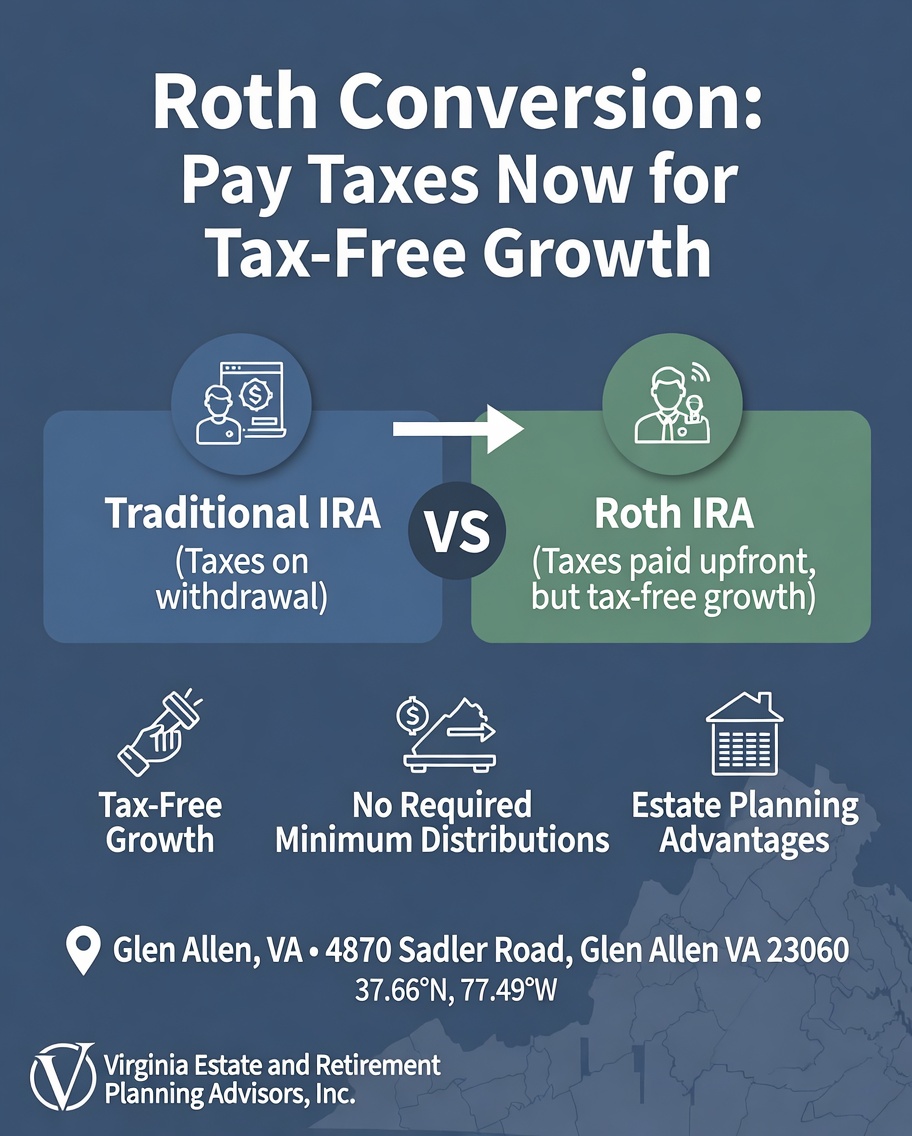
A Roth conversion is the process of moving money from a traditional IRA or other pretax retirement account into a Roth IRA, where you pay taxes now in exchange for tax-free withdrawals in retirement. This financial move has become popular among people looking to manage their future tax bills and create more flexibility in their retirement plans.
The decision to convert isn’t simple. You need to understand how the conversion works, what taxes you’ll owe, and whether it makes sense for your situation. Your age, income, tax bracket, and retirement timeline all play a role in determining if a Roth conversion is right for you.
This guide will walk you through everything you need to know about Roth conversions. You’ll learn the basic mechanics, tax strategies to reduce what you owe, important rules and deadlines, and how conversions affect other parts of your retirement. You’ll also discover common mistakes to avoid and when it makes sense to work with a professional.
How Roth Conversions Work
A Roth conversion moves money from pre-tax retirement accounts into a Roth IRA, requiring you to pay taxes on the conversion amount in the year you convert. You can use different methods to complete the transfer, and the process varies depending on your account type and timing.
Eligible Accounts and Conversion Methods
You can convert several types of retirement accounts to a Roth IRA. These include traditional IRAs, SEP IRAs, SIMPLE IRAs (after two years), and employer-sponsored plans like 401(k)s and 403(b)s.
Three main methods exist for completing a Roth conversion:
- Direct rollover: Your plan administrator sends funds directly to your Roth IRA
- Trustee-to-trustee transfer: Money moves between financial institutions without you touching it
- Indirect rollover: You receive a check and must deposit it into your Roth IRA within 60 days
The same-trustee transfer is the simplest option when your traditional IRA and Roth IRA are at the same institution. Direct transfers avoid potential tax withholding and missed deadline issues that can occur with indirect rollovers.
Traditional IRA vs. 401(k) Conversions
Converting a traditional IRA to a Roth IRA is straightforward since both accounts are individual retirement accounts. You can convert any amount you choose, and the process typically takes just a few days to complete.
A 401(k) conversion requires additional steps. You must first check if your employer plan allows in-service withdrawals or if you need to leave your job first. Many people roll their 401(k) into a traditional IRA first, then convert to a Roth IRA. Some employers allow direct 401(k) to Roth IRA conversions.
The tax impact differs between account types. Traditional IRA conversions tax the entire amount if you made only pre-tax contributions. With 401(k) conversions, any after-tax contributions you made won’t be taxed again during the conversion.
Conversion Timing and Deadlines
You can complete a Roth conversion at any time during the year. The conversion counts as income for the tax year when you complete it, not when you initiate it.
The December 31 deadline matters for tax purposes. Any conversion completed by this date counts toward that tax year. You cannot spread the conversion across multiple tax years by starting in December and finishing in January.
Indirect rollovers have a strict 60-day rule. You must deposit the funds into your Roth IRA within 60 days of receiving them. Missing this deadline means the distribution becomes taxable, and you may face a 10% early withdrawal penalty if you’re under age 59½.
Unlike previous years, Roth conversions are now permanent. You cannot reverse or “recharacterize” a conversion back to a traditional IRA after completing it.
Tax Implications and Calculation Strategies
A Roth conversion adds to your taxable income in the year you complete it, which can push you into higher tax brackets and increase your overall tax bill. The amount you owe depends on your marginal tax rate, filing status, state tax requirements, and how the pro-rata rule applies to your IRA balance.
Taxable Income and Tax Bracket Considerations
The conversion amount gets added to your ordinary income for the tax year. This means if you convert $50,000 and your salary is $80,000, your taxable income becomes $130,000 before deductions.
Your marginal tax rate determines what percentage you pay on the converted funds. The federal tax brackets for 2026 range from 10% to 37%, depending on your income level and filing status. Converting too much in one year can push you into a higher tax bracket.
You should calculate how much room you have in your current tax bracket before jumping to the next one. For example, if you’re $15,000 away from the next bracket, converting exactly $15,000 keeps you from paying the higher rate. A roth conversion calculator helps you model different conversion amounts and see the tax impact before you commit.
Tax credits can reduce your final tax bill, but they don’t change the fact that conversions count as taxable income. You need to plan conversions around your other income sources to avoid unexpected jumps in your tax burden.
Managing the Conversion Tax Bill
You must pay conversion taxes from funds outside your IRA when possible. Using money from the conversion itself to pay taxes reduces the amount going into your Roth IRA and triggers early withdrawal penalties if you’re under 59½.
Consider spreading large conversions across multiple years to stay in lower tax brackets. Converting $100,000 over two years instead of one can save thousands in taxes if it keeps you out of higher brackets each year.
You can complete conversions at any time during the year, but the tax applies to that entire tax year. Some people wait until late in the year when they know their exact income, while others convert early to start tax-free growth sooner.
Pro-Rata Rule and Nondeductible IRAs
The pro-rata rule requires you to calculate the taxable portion of your conversion based on your total traditional IRA balance across all accounts. You can’t simply convert only nondeductible IRA contributions to avoid taxes.
The IRS looks at your combined balance in all traditional, SEP, and SIMPLE IRAs on December 31st of the conversion year. If you have $90,000 in pre-tax funds and $10,000 in nondeductible contributions, only 10% of any conversion is tax-free, regardless of which account you convert from.
This rule affects people who made nondeductible contributions to traditional IRAs. Your basis (the after-tax money you already contributed) reduces the taxable amount, but you must apply it proportionally across all conversions that year.
State Tax and Filing Status Impact
Your filing status affects which tax brackets apply to your conversion. Married couples filing jointly have wider tax brackets than single filers, meaning they can convert more before hitting higher rates.
State tax adds another layer of cost in most states. Nine states have no income tax, but others charge between 2% and 13% on conversion income. California and New York have particularly high rates that significantly increase your total conversion taxes.
Some states offer preferential treatment for retirement income, but most treat Roth conversions the same as ordinary income. You need to factor in both federal and state rates when calculating whether a conversion makes sense financially.
Key Rules, Deadlines, and Limits
The conversion deadline falls on December 31 of each tax year with no extensions available. You face no annual limits on conversion amounts, but specific rules govern when you can access converted funds without penalties and how conversions interact with required distributions.
Five-Year Rule and Tax-Free Withdrawals
Each Roth conversion starts its own five-year clock beginning January 1 of the year you complete the conversion. You must wait five years from this date before withdrawing the conversion amount penalty-free if you’re under age 59½.
The five-year rule applies separately to each conversion you make. If you convert $30,000 in 2026 and another $20,000 in 2027, each amount has its own five-year waiting period.
Your earnings on the conversion amount follow different rules. These earnings can be withdrawn tax-free and penalty-free once you reach age 59½ and your Roth IRA has been open for at least five years. Before meeting both conditions, you’ll owe income tax and potentially a 10% penalty on earnings withdrawals.
Required Minimum Distributions (RMD) Rules
You must take your RMD from traditional retirement accounts before converting funds in the same year. The IRS does not allow you to satisfy your RMD requirement through a Roth conversion.
If you’re 73 or older, calculate and withdraw your required minimum distribution first. Only the remaining balance qualifies for conversion to a Roth IRA. Missing this step means the IRS treats the first dollars distributed as your RMD, which cannot be converted.
Roth IRAs have a major advantage: they don’t require distributions during your lifetime. Once you convert funds and pay the taxes, those assets grow without forced withdrawals.
Early Withdrawal Penalty and Exceptions
The 10% penalty applies to conversions withdrawn before the five-year period ends if you’re under 59½. This penalty hits only the converted amount, not the taxes you already paid on it.
Several exceptions let you avoid the 10% penalty:
- Reaching age 59½
- Permanent disability
- First-time home purchase (up to $10,000)
- Qualified education expenses
- Certain medical expenses exceeding 7.5% of adjusted gross income
You can always withdraw your original Roth IRA contributions without taxes or penalties. The ordering rules matter: contributions come out first, then conversions (oldest first), then earnings last.
Advanced Roth Conversion Strategies
Several strategies can help you manage the tax impact of Roth conversions while maximizing long-term benefits. These approaches focus on controlling conversion amounts, using specialized contribution methods, and timing conversions to fit your tax situation.
Partial vs. Full Conversions
You don’t have to convert your entire traditional IRA balance at once. A partial Roth IRA conversion lets you move only a portion of your funds in a given year.
This approach helps you control the conversion amount and stay within a specific tax bracket. For example, if you’re in the 24% tax bracket, you might convert just enough to reach the top of that bracket without pushing income into the 32% bracket.
A full Roth IRA conversion moves your entire traditional IRA balance in one year. This makes sense if you expect higher tax rates in the future or if you have a low-income year. The downside is a larger tax bill all at once.
Use a Roth conversion calculator to estimate taxes for different conversion amounts. This helps you decide whether partial or full conversions work better for your situation.
Backdoor Roth and Mega Backdoor Roth Approaches
A backdoor Roth IRA lets high-income earners fund a Roth IRA when they earn too much for direct contributions. You make a non-deductible contribution to a traditional IRA, then convert it to a Roth IRA.
Watch out for the pro-rata rule. If you have other traditional IRA funds, the IRS treats your conversion as coming proportionally from pre-tax and after-tax money.
The mega backdoor Roth works through your employer plan. You make after-tax contributions to your 401(k) beyond the standard limit, then convert those funds to a Roth account. Your employer plan must allow both after-tax contributions and in-service conversions for this strategy to work.
Fill-the-Bracket and Roth Conversion Ladder
Fill-the-bracket means converting just enough each year to reach the top of your current tax bracket. You maximize conversions while avoiding higher rates.
Check your taxable income first, then calculate how much room you have before hitting the next bracket. Convert that amount from your traditional IRA.
A Roth conversion ladder helps you access retirement funds before age 59½ without penalties. You convert traditional IRA funds to a Roth IRA, then wait five years to withdraw the converted amount penalty-free.
This works well if you retire early. Convert amounts each year that match your expected spending five years later. The expected annual return on your investments can grow these converted funds while you wait out the five-year period.
Impact on Medicare, Social Security, and Retirement Planning
A Roth conversion increases your modified adjusted gross income in the year you convert, which can trigger higher Medicare premiums two years later and increase taxes on Social Security benefits. Understanding these costs helps you plan conversions that balance long-term tax savings against short-term expenses.
Income-Related Medicare Premiums (IRMAA)
Medicare uses your income from two years ago to set your Part B and Part D premiums. When you do a Roth conversion, that converted amount counts as taxable income and can push you into higher IRMAA brackets.
The income-related monthly adjustment amounts work on a tier system. If your income exceeds certain IRMAA thresholds, you pay surcharges on top of standard Medicare premiums. For 2026, these IRMAA surcharges are based on your 2024 income.
A large conversion can bump you up one or more brackets. This means you might pay several hundred to several thousand dollars more per year in Medicare premiums for that one year.
You can plan around IRMAA by spreading conversions across multiple years instead of doing one large conversion. This keeps your income below the next threshold and avoids the IRMAA cliff effect where a small income increase triggers a large premium jump.
Effect on Social Security Taxation
Roth conversions increase your provisional income, which determines how much of your Social Security benefits get taxed. Up to 85% of your benefits can become taxable when your income crosses certain levels.
Your provisional income includes half of your Social Security benefits plus your adjusted gross income and tax-exempt interest. A Roth conversion adds directly to this calculation in the year you convert.
If you’re already at the 85% taxation threshold, a conversion won’t make your Social Security more taxable. But if you’re below that level, a conversion could push you into higher taxation territory.
Retirement Savings and RMD Elimination
Roth IRAs don’t have required minimum distributions during your lifetime. Converting traditional retirement savings to a Roth IRA eliminates future RMDs from those converted amounts.
This gives you more control over your retirement income. You won’t be forced to take distributions that could push you into higher tax brackets or trigger IRMAA surcharges later.
Tax-free growth in a Roth IRA means your money compounds without creating future tax bills. The assets grow and can be withdrawn without affecting your income calculations for Medicare or Social Security taxation.
Converting before RMDs start lets you manage your tax bracket more effectively. You can convert amounts that fill up lower tax brackets now instead of being forced into higher brackets by RMDs later.
Professional Guidance and Mistakes to Avoid
Roth conversions involve complex tax calculations and long-term financial planning that can significantly impact your retirement. The difference between a well-executed conversion and a costly error often comes down to getting the right help and avoiding common traps.
When to Consult a Financial or Tax Advisor
You should consult a qualified financial advisor or tax advisor before executing any Roth conversion, especially if you’re converting large amounts. These professionals can evaluate your specific tax situation and help you coordinate conversions with other retirement strategies.
A tax advisor becomes particularly important when your conversion could push you into a higher tax bracket or trigger Medicare surcharges. They can calculate the exact tax impact and identify the optimal conversion amount for your situation.
Financial advisors help you integrate conversions into your broader retirement plan. They can model how conversions affect your long-term wealth, estate planning, and required minimum distributions. This coordination ensures your conversion strategy aligns with your other financial goals.
The cost of professional guidance is typically far less than the mistakes you might make on your own. A single error in timing or amount can cost you thousands in unnecessary taxes.
Common Pitfalls and Hidden Costs
Converting too much in one year is a frequent mistake that pushes you into higher tax brackets unnecessarily. You pay more in taxes than needed when you could have spread conversions over multiple years at lower rates.
Medicare premium surcharges (IRMAA) are a hidden cost many people miss. If your conversion increases your income above certain thresholds, you’ll pay higher Medicare Part B and Part D premiums two years later.
Failing to account for state income taxes can also inflate your conversion costs. Some states tax Roth conversions while others don’t, and this varies significantly by location.
Not having cash outside your retirement accounts to pay conversion taxes forces you to withhold funds from the conversion itself. This reduces the amount that moves to your Roth and can trigger early withdrawal penalties if you’re under 59½.
Using Calculators and Modeling Tools
A Roth conversion calculator helps you estimate the tax cost and long-term benefits of converting specific amounts. These tools let you model different conversion scenarios and compare outcomes before committing.
Most calculators require you to input your current tax bracket, expected retirement tax bracket, and years until retirement. They then project whether the upfront tax cost will be offset by future tax-free growth.
Keep in mind that investing involves risk and calculators provide estimates, not guarantees. They can’t predict future tax law changes or market performance with certainty.
The best calculators account for Medicare surcharges, state taxes, and required minimum distributions. Some planning software also models multi-year conversion strategies to help you optimize the total amount converted while managing your tax bracket each year.
Frequently Asked Questions
Moving money from a traditional IRA to a Roth IRA triggers specific tax obligations and follows set rules that many people find confusing. The conversion amount gets added to your taxable income for the year, the five-year rule determines when you can access earnings tax-free, and no income or contribution limits restrict how much you can convert.
How do I estimate the taxes I would owe when moving money from a pre-tax IRA into a Roth account?
The amount you convert gets added to your regular income for the year. This means you need to add the conversion amount to your salary, interest, dividends, and other income to find your total taxable income.
Your tax bill depends on which tax bracket that total income puts you in. If you earn $80,000 from your job and convert $30,000, your taxable income becomes $110,000 before deductions.
You can use tax software or online calculators to estimate your tax liability. Most calculators let you enter your expected income and conversion amount to see how much tax you would owe.
Working with a tax professional helps you get a more accurate estimate. They can account for deductions, credits, and state taxes that affect your final tax bill.
What are the main advantages and potential drawbacks of shifting retirement funds into a Roth structure?
The biggest advantage is tax-free growth and withdrawals in retirement. You never pay taxes on the money again after you convert and pay the initial tax bill.
Roth accounts do not require withdrawals at age 73 like traditional IRAs do. This gives you more control over your retirement income and lets the money grow longer if you don’t need it.
Your heirs can inherit Roth accounts tax-free. They must take distributions, but they won’t owe income tax on the withdrawals.
The main drawback is paying taxes upfront. You need cash available to pay the tax bill without using funds from the conversion itself.
Converting can push you into a higher tax bracket for that year. This might increase what you pay for Medicare premiums or reduce eligibility for certain tax credits.
You lose access to the money you use to pay conversion taxes. That cash could have been invested or used for other financial goals.
Are there income or dollar limits that restrict how much I can move into a Roth account in a given year?
No income limits exist for conversions. High earners who cannot contribute directly to a Roth IRA can still convert traditional IRA funds.
You can convert any amount in a single year. There is no cap on how much you can move from a traditional IRA to a Roth IRA.
You can split conversions across multiple years to manage your tax bracket. Converting smaller amounts over several years often results in lower total taxes than one large conversion.
Annual contribution limits do not apply to conversions. The $7,000 contribution limit for 2026 (or $8,000 if you’re 50 or older) only affects new money you put into IRAs, not money you convert between account types.
How does the five-year rule work for withdrawals after moving funds into a Roth account?
Each conversion starts its own five-year clock. You must wait five years from January 1 of the conversion year to withdraw that specific conversion amount penalty-free if you’re under age 59½.
The five-year rule only affects the converted amount, not the earnings. If you withdraw converted funds before five years pass and you’re under 59½, you pay a 10% penalty on that withdrawal.
Once you reach age 59½, you can withdraw conversion amounts anytime without penalty. The five-year waiting period no longer applies to you.
Earnings on converted amounts follow different rules. You must have any Roth IRA open for five years and be at least 59½ to withdraw earnings tax-free and penalty-free.
Your first Roth IRA contribution or conversion starts the five-year clock for earnings. All your Roth IRAs share this same clock for the earnings rule.
What strategies can reduce or manage the tax impact when moving pre-tax retirement money into a Roth account?
Convert during low-income years to stay in a lower tax bracket. Years when you retire early, take a sabbatical, or have reduced business income work well for conversions.
Fill up your current tax bracket without jumping to the next one. Calculate how much income space you have left in your bracket and convert only that amount.
Pay conversion taxes from a taxable account instead of the IRA itself. Using outside funds to cover taxes leaves more money in your Roth IRA to grow tax-free.
Convert when the market drops and your account value is lower. You pay taxes on a smaller amount, and the future recovery grows tax-free in your Roth account.
Time conversions in years before you claim Social Security or start required minimum distributions. This keeps your taxable income lower and reduces Medicare premium increases.
Spread conversions over multiple years to avoid a single large tax hit. This strategy helps you manage which tax bracket you land in each year.
What is the step-by-step process to move funds from a traditional IRA into a Roth IRA at a major brokerage?
Log into your brokerage account online or call their customer service line. Most major brokerages let you complete conversions through their website or app.
Look for the conversion or transfer option in your account menu. This might be under “Account Services,” “Move Money,” or a similar section.
Select your traditional IRA as the source account and your Roth IRA as the destination. If you don’t have a Roth IRA yet, the brokerage will create one during the conversion process.
Enter the amount you want to convert. You can choose to convert your entire balance or specify a dollar amount.
Choose whether to convert cash or specific investments. Some brokerages let you move investments directly without selling them first.
Review and confirm the conversion details. Make sure the amounts and accounts are correct before you submit.
The brokerage processes the conversion, usually within one to three business days. You receive a confirmation once the transfer completes.
You will get a Form 1099-R the following January showing the conversion amount. This form helps you report the conversion on your tax return for the year you completed it.